

Hand in Hand Coaching
Grow stronger as a family - one practical theme at a time.
Private virtual coaching that brings the twelve themes in Hand in Hand: Growing Up Together to life for parents and teens. Two sessions each month. A clear focus. Practical tools tailored to your family.
You care deeply. The hard part is knowing what to practice next.
“Good intentions do not always become better conversations.”
Parents may know they want to respond with more steadiness but fall back into correction, control, or frustration. Teens may want greater trust and independence but struggle to explain what they need. After conflict, everyone may care about repairing the relationship without knowing how to begin.
Hand in Hand Coaching turns broad goals into focused practice. Each month gives your family shared language, guided reflection, and a practical skill to use between sessions - so growth becomes something you do together, not something you keep talking about doing.
Who is Hand in Hand Coaching for?
Hand in Hand Coaching is for parents, adults, and teens who want to strengthen their relationships, deepen connection, communicate more effectively, and build lasting trust. It can also benefit teachers, school administrators, coaches, youth leaders, mentors, caregivers, and other professionals who support young people and families. Coaching is practical, forward-focused, and shaped around each person’s goals, with sessions designed for individuals, families, or professionals seeking tools they can apply in everyday life and work.

Adults & Parents
Understand what may be happening beneath the behavior, communicate with less escalation, set clearer boundaries, and guide without trying to control every outcome.
Lead with steadiness.

Parents + Teens Together
Build shared language for emotions, expectations, repair, responsibility, and growth - with a neutral guide helping everyone practice a better way forward.
Grow alongside each other.

Teens
Understand emotions, build confidence, make stronger decisions, communicate more clearly, and take greater ownership without feeling alone.
Grow with support and agency.
What coaching can help your family strengthen
• Communicate more clearly when emotions are high.
• Recognize feelings, needs, capacity, and patterns before they become reactions.
• Build confidence through preparation, courage, and repeated action.
• Strengthen motivation, decision-making, ownership, and follow-through.
• Create boundaries that protect both responsibility and connection.
• Recover from setbacks with greater flexibility and resilience.
• Repair after conflict instead of letting resentment take over.
• Prepare teens for adulthood with stronger time, technology, and leadership habits.
Coaching supports skill development and action; outcomes vary by family, participation, and circumstances.
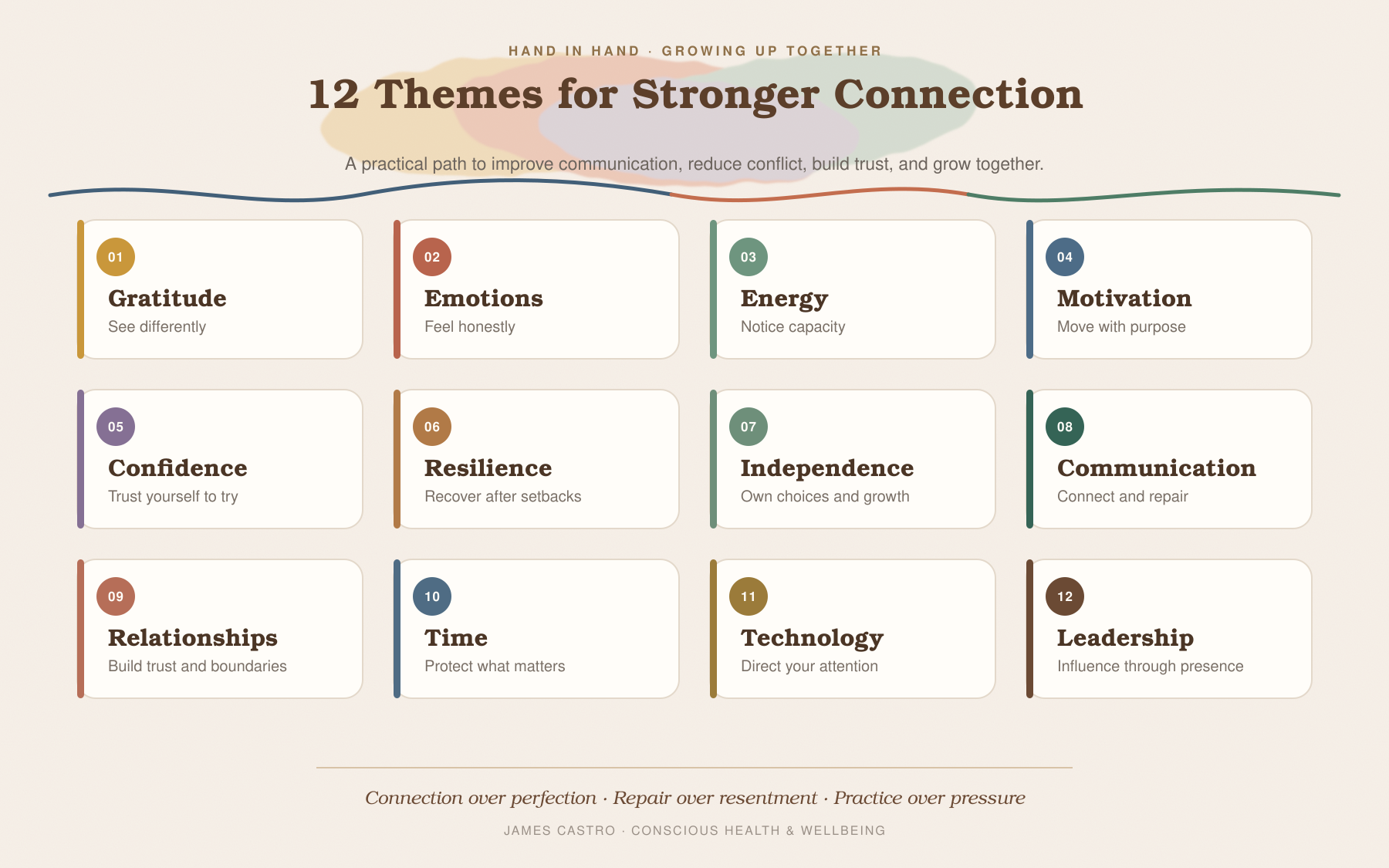
A twelve-theme map for growing up together
Hand in Hand: Growing Up Together organizes growth into twelve themes. Each develops a different skill, but all move toward the same goal: helping teens become emotionally healthy, self-aware, capable young adults while helping parents become steadier guides instead of constant fixers.




Why work with James
Deep experience. Practical guidance. Respect for every person in the room.
James Castro, LPC, LMFT, has served as a licensed counselor and marriage and family therapist since 1999. For more than 25 years, he has worked with adolescents, adults, couples, and families across everyday challenges and more complex circumstances.
That experience helps James notice the deeper pattern without shaming anyone for being human. His coaching style is warm, grounded, practical, and direct. He helps families slow down, find useful language, choose a next step, and practice it in real life.
Coaching is not counseling
Hand in Hand Coaching is a separate, non-clinical service. It is future-focused and educational, with an emphasis on goals, skills, action, and accountability. It does not diagnose or treat mental-health conditions and is not a substitute for therapy, emergency care, or crisis support.
Frequently asked questions.
-
No. Coaching is a non-clinical, future-focused service centered on education, goals, skills, action, and accountability. It is not used to diagnose or treat mental-health conditions.
-
Your family decides who attends each session: a parent, a teen, or both together. James helps you choose the most useful format while clarifying parent involvement and privacy expectations before coaching begins.
-
No. The themes are introduced and applied as you move through the package. Complete Journey is the only package designed to cover the full twelve-theme curriculum.
-
Foundation families choose four themes and Momentum families choose eight, with Gratitude required as the starting point. James helps connect the remaining choices to your family's goals.
-
Yes. The supplied package structure is virtual coaching. Technology, scheduling, rescheduling, and participation expectations are confirmed before enrollment.
-
Choose Foundation for a focused start, Momentum for more time to build habits across eight themes, and Complete Journey for the full curriculum and highest level of between-session support.
-
James will be direct about fit. Coaching should not replace licensed clinical care when that is needed. Immediate safety concerns should be directed to emergency or crisis services.